English
  Tiếng Việt
Do dental implants affect MRI scans or trigger metal detectors at airport security?
In fact, dental implants do not affect MRI scans, metal detectors, or airport security screening. Titanium implant posts are non-magnetic, making them safe for medical imaging and travel. Let The East Rose Dental help you better understand the facts and feel more confident about choosing dental implants.
What Are Dental Implants Made Of?
Dental implants are primarily made from titanium, a medical-grade material widely used in modern dentistry for its lightweight strength, exceptional durability, and excellent corrosion resistance. One of titanium’s greatest advantages is its biocompatibility, meaning it can integrate naturally with the human body without causing allergic reactions or rejection. Once placed into the jawbone, the implant functions like an artificial tooth root, providing long-term stability and support for the final restoration.
From a medical and physical standpoint, titanium is a non-magnetic material. Unlike metals such as iron or nickel, titanium does not react to magnetic fields. This means it is safe for MRI scans, does not trigger airport metal detectors in most cases, and does not interfere with modern security screening systems.
Can You Fly or Have an MRI After Getting Dental Implants?
Many people wonder whether dental implants can affect MRI scans or airport security checks. In simple terms, an MRI machine works like a giant magnet that captures detailed images inside the body, which is why magnetic metals such as iron can be strongly affected during scanning. Airport security systems, on the other hand, use electromagnetic technology to detect large metal objects or materials with high electrical conductivity.
However, dental implants are made from titanium, a special material that is non-magnetic and has very low electrical conductivity. Because of these properties, titanium implants do not react to the magnetic field used in MRI scans and are generally too small to trigger airport metal detectors or security screening systems.
For this reason, dental implants usually do not interfere with flying or MRI procedures. During an MRI scan, the implant remains stable, does not move, and does not become dangerously hot inside the body. At airports, you can also pass through security checkpoints normally without worrying about being stopped because of your implants.
In most cases, patients with dental implants can travel, undergo routine medical imaging, and continue daily activities comfortably without requiring any special preparation.
3 Situations Where Dental Implants May Affect MRI Scans or Metal Detectors
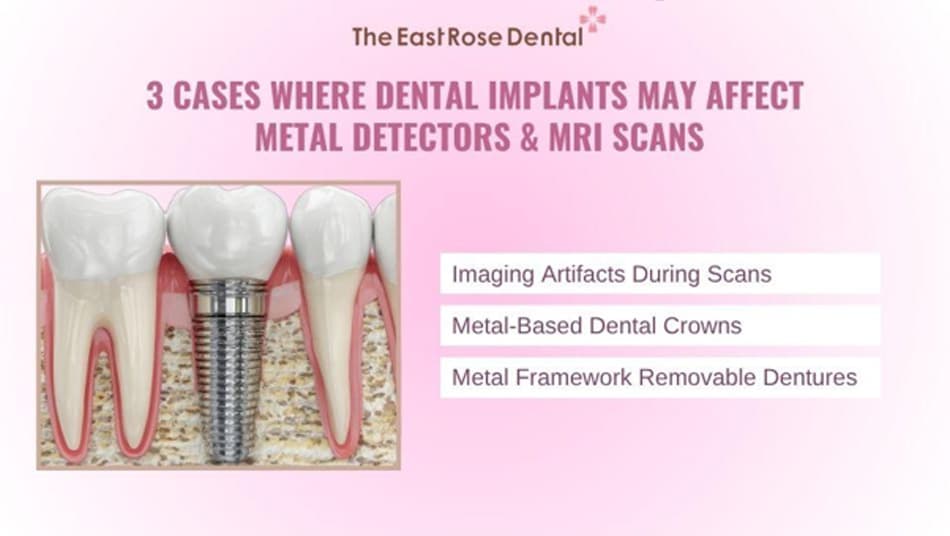
Although titanium dental implants are considered very safe, there are still a few situations where minor interference may occur. Understanding these cases can help you feel more prepared before undergoing medical imaging or airport security screening.
Imaging Distortion During MRI or CT Scans
While titanium is non-magnetic and safe for MRI procedures, it is still a solid metal object. During MRI or CT scans of the head and facial area, the implant may create image distortion, also known as an artifact. This can appear as shadows or blurred streaks around the implant site.
Although this does not pose any health risk, it may make it more difficult for doctors to clearly examine nearby soft tissue or bone structures. In such cases, you should inform the technician beforehand so the imaging settings can be adjusted to reduce interference as much as possible.
Metal-Based Dental Crowns or Restorations
Another factor to consider is the dental crown attached to the implant. If you are using porcelain-fused-to-metal crowns or restorations made from alloys such as cobalt-chromium or nickel-chromium instead of all-ceramic crowns, these materials may have higher magnetic sensitivity than titanium.
As a result, they can occasionally cause stronger imaging artifacts during MRI scans or, in rare cases, trigger highly sensitive metal detectors during security checks.
Removable Dentures with Metal Frameworks
If you wear an implant-supported removable denture, the denture framework itself may contain a larger amount of metal. Unlike the implant post embedded inside the jawbone, removable metal frameworks are more likely to be detected by security systems or interfere with MRI imaging.
For this reason, it is generally recommended to remove removable dentures before entering an MRI room or undergoing certain security screening procedures to ensure the process is smooth and safe.
How Soon After Dental Implant Surgery Can You Fly or Have an MRI?
You generally do not need to wait very long before flying or undergoing an MRI after dental implant surgery. However, following the recommended recovery timeline can help ensure greater comfort and proper healing.
Flying After Dental Implant Surgery
In most cases, patients can fly within 24-48 hours after implant placement. However, the ideal timeframe is usually 3-5 days later, once swelling and discomfort have reduced and the blood clot has stabilized.
Flying too soon after surgery may cause discomfort because cabin pressure changes can place additional pressure on the sinus area and newly treated tissues. If you have undergone additional procedures such as a sinus lift together with implant placement, your dentist may recommend waiting around two weeks before air travel for optimal safety and healing.
Having an MRI After Dental Implant Surgery
Technically, MRI scans can be performed immediately after implant placement because titanium does not react to magnetic fields. However, dentists often recommend waiting 1-2 weeks so the surrounding soft tissues have time to heal and swelling can fully subside.
Remaining still inside the MRI machine for an extended period may feel uncomfortable if the surgical area is still sensitive. Most importantly, you should always inform the doctor or MRI technician that you recently had dental implant surgery so appropriate imaging adjustments can be made if necessary.
Important Notes for Dental Implant Patients Before Flying or Having an MRI
Important Notes for Patients with Dental Implants
To ensure smooth travel and medical examinations, keep the following important points in mind:
- Inform medical staff in advance: Before having an MRI scan, always let the doctor or technician know that you have dental implants. This helps them adjust the imaging settings to minimize image artifacts and improve scan clarity around the head and jaw area.
- Carry your implant card or warranty card: Although titanium implants rarely trigger airport metal detectors, it is still recommended to carry your implant card, which usually contains information about the implant system and material. If a highly sensitive detector is activated, the card can help speed up the security process.
- Remove removable dentures if necessary: If you wear an implant-supported removable denture, you may be asked to remove it before entering the MRI room or passing through airport security. Metal frameworks in removable prosthetics are more likely to be detected than implant posts inside the jawbone.
- Take care of the surgical area when flying: Cabin pressure changes may create pressure around the sinus area and recently treated tissues. If you had implant surgery within the past week, bring any prescribed pain medication and stay hydrated during the flight to help reduce discomfort.
- Choose the right crown material: If you frequently undergo medical imaging or travel internationally, all-ceramic crowns may be a better option than metal-based restorations. Because they contain no metal, they help minimize the risk of imaging interference or unnecessary security alerts.
3 Common Questions About Dental Implants

Besides concerns about whether dental implants affect MRI scans or airport security systems, many patients also ask about dental crowns, braces, and dentures during medical imaging procedures. Here are the answers to some of the most common questions.
1 - Do Metal-Based Dental Crowns Affect Imaging Results?
Yes, mild image distortion may occur. If the dental crown contains a metal framework, it can create shadows or blurred streaks in scans around the mouth area. However, this only affects image clarity and does not pose any health risk. For the best imaging quality, all-ceramic crowns are generally recommended.
2 - Can Patients with Metal Crowns or Braces Have an MRI?
Yes. MRI scans can still be performed safely, although metal components may cause image artifacts or blurry areas on the scan. You should inform the technician beforehand so the imaging settings or scan angles can be adjusted appropriately.
3 - Can Patients with Dentures Undergo MRI Scans?
If you wear removable dentures with metal clasps or frameworks, they should usually be removed before the scan. Fixed restorations such as dental implants or bridges generally do not interfere with MRI procedures.
We hope this article has helped ease your concerns about whether dental implants can affect MRI scans or airport security checks. Thanks to modern dental technology, titanium implants not only provide long-term strength and stability for chewing, but also offer excellent safety and convenience for everyday life, travel, and medical care.
Services

Working Time
- Monday - Friday: 08:00 - 19:00
- Saturday: 08:00 - 18:00
- Sunday closed
Contact Info
- Hotline 1: 1900 585 874
- Hotline 2: (+84)838 258 778
- Mobile: (+84)908 321 455
- Phone: (+84)2 838 258 778
- info@dentalrose.net
- rosedentalclinicvn@gmail.com