English
  Tiếng Việt
Do Veneers show exposed margins? Why do some look fake?
Porcelain veneers are highly favored for their aesthetic benefits, but many people still worry about whether veneers may expose visible margins or appear “fake” after treatment. In reality, the final result depends on multiple factors, including the dentist’s technique and the quality of materials used. So why do some veneer cases look extremely natural while others appear less aesthetic? Let The East Rose Dental explain in detail below.
Do Porcelain Veneers Show Visible Margins?
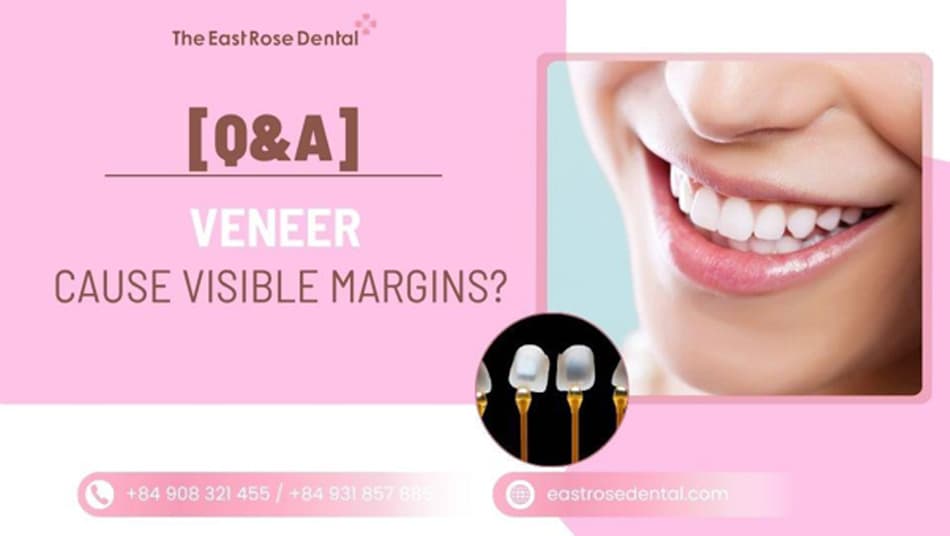
Technically, porcelain veneers will NOT expose visible margins if the procedure is performed correctly and with high precision. This depends entirely on the design of the “finish line”, the critical transition area between the veneer and the natural tooth structure.
A proper finish line requires careful tooth preparation at the gumline or approximately 0.3-0.5mm below the gum margin, creating a smooth transition so the veneer and natural tooth blend into one unified structure. When the fit is highly precise, the veneer margins will not create gaps or bulky edges, helping prevent food accumulation and darkened gumlines while maintaining a natural-looking smile.
5 Causes of Visible Veneer Margins and Unnatural-Looking Results
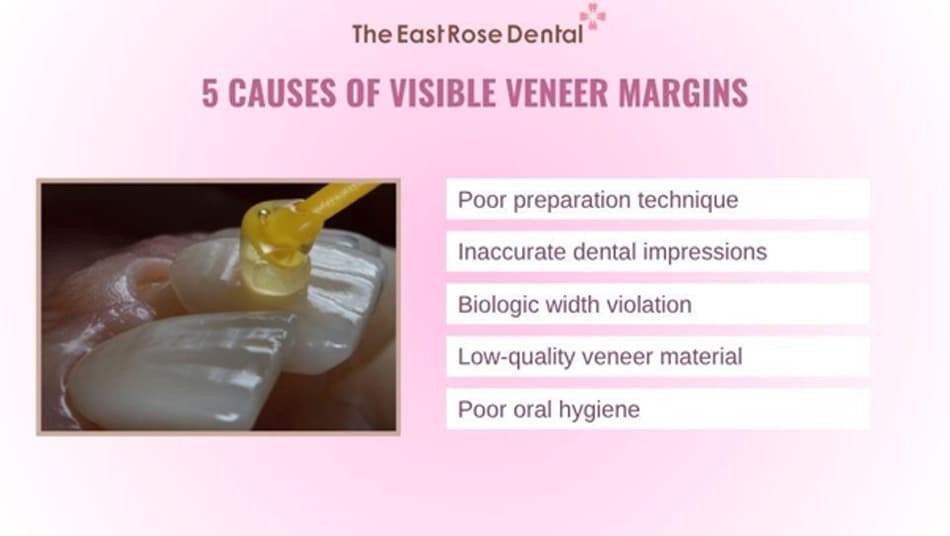
Visible gumline margins or unnatural-looking veneers not only affect aesthetics but may also increase the risk of oral health problems. Below are the main causes that can make veneers appear “fake.”
1. Poor Dentist Technique and Improper Tooth Preparation
This is the most important factor affecting how seamlessly veneers fit against natural teeth. If the dentist miscalculates the preparation ratio or creates an uneven finish line, tiny micro-gaps may appear after bonding.
Even small inaccuracies during impression taking may cause veneers to feel uneven or bulky. These gaps not only make veneer margins visible but also create areas where plaque and bacteria accumulate, potentially leading to darkened gumlines and chronic bad breath.
2. Errors During Impression Taking and Laboratory Fabrication
Even when tooth preparation is correct, inaccurate impressions, whether traditional or digital, may prevent the dental laboratory from identifying veneer margins precisely.
As a result, the veneer may become either oversized or undersized. Oversized veneers can irritate the gums, while undersized veneers may leave visible gaps between the tooth and veneer. Both situations interrupt the smooth transition around the cervical area, making the margin line more noticeable.
3. Violation of the Biological Width Causing Gum Recession
The biological width refers to the soft tissue attachment around the tooth neck that protects the supporting bone. If veneer margins are placed too deeply into this area, the body may respond with chronic gum inflammation. Over time, the gums may recede in an attempt to separate from the irritation source. Once gum recession occurs, the hidden junction between the veneer and natural tooth becomes exposed, creating a clearly visible and unaesthetic margin.
4. Low-Quality Veneer Materials
The quality of ceramic materials directly affects color stability and margin durability. Low-cost veneer materials often have poor thermal compatibility with natural teeth and may oxidize more easily in the acidic oral environment.
Over time, the veneer edges may wear down or discolor, creating dark shadows near the gumline. In addition, low-quality bonding cement may absorb oral fluids, leading to microscopic debonding that exposes the veneer margins more clearly.
5. Improper Oral Hygiene Habits
Post-treatment care plays a major role in maintaining natural-looking veneer margins. Aggressive brushing with hard-bristle toothbrushes or horizontal brushing techniques may gradually damage sensitive gum tissue and contribute to gum recession.
Once the gums recede and no longer cover the finish line, the junction between the veneer and natural tooth becomes fully exposed. This not only affects aesthetics but may also increase tooth sensitivity around the cervical area.
Read more: 5 Outstanding Benefits of Ultra-Thin Porcelain Veneer
How to Fix Visible Gumline Margins After Veneers
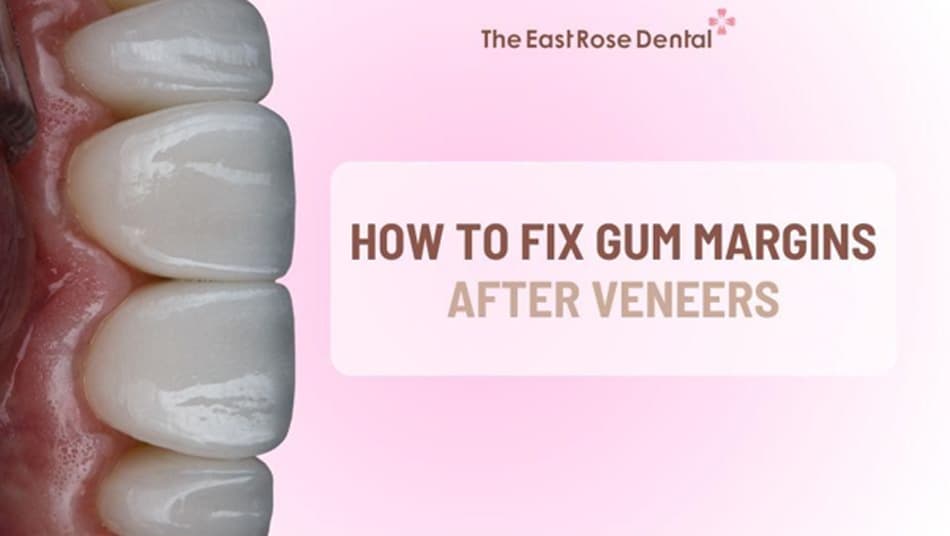
When visible veneer margins appear after treatment, timely intervention is important not only for aesthetics but also for protecting long-term oral health. Depending on the specific cause and severity, dentists will recommend the most suitable treatment approach. Below are the professional correction steps performed at The East Rose Dental.
Step 1: Clinical examination and diagnosis
The dentist will carefully examine whether the visible margins are caused by poor veneer adaptation, gum recession, or biological width inflammation. In some cases, X-rays may be required to evaluate the finish line adaptation and the supporting bone structure beneath the veneers.
Step 2: Treating gum disease if present
If the visible margins are related to gum inflammation or periodontal pockets, inflammation must be treated first. The dentist may perform professional cleaning, deep scaling, or periodontal therapy to eliminate bacteria. Once the gum tissue becomes healthy again, the gumline can be accurately reassessed for further treatment.
Step 3: Removing old veneers and cleaning the tooth surface
In most cases involving technical errors or open margins, replacing the old veneers is the most effective solution. Specialized instruments are used to gently remove the veneers while minimizing damage to the natural tooth structure. After removal, all residual cement and plaque are thoroughly cleaned before preparing for a new restoration process.
Step 4: Refining the finish line and taking digital impressions
After surface preparation, the dentist will redesign the finish line to achieve a smoother and more harmonious transition with the current gumline. Modern 3D scanning technology is often used at this stage to capture highly precise digital impressions. Accurate impressions are essential to ensure the new veneers fit seamlessly without exposing margins.
Step 5: Fabricating and bonding new veneers
Based on the updated digital data, dental technicians fabricate new veneers with the most suitable shape and color. During bonding, the dentist uses specialized resin cement with compatible shade tones to create a natural transition between the veneers and gum tissue.
After placement, the veneers are carefully checked under a dental microscope to confirm optimal adaptation and ensure the margins remain virtually invisible for long-lasting natural aesthetics.
Porcelain veneers are considered a premium cosmetic dental solution, but truly natural and seamless results can only be achieved when treatment is performed by experienced dentists using high-quality materials. With advanced fabrication technology and a team of dentists possessing 16-27 years of experience, The East Rose Dental is committed to delivering natural-looking smiles, precise adaptation, and facial harmony. Let us help you achieve greater confidence together with long-term oral health.
Services
Working Time
- Monday - Friday: 08:00 - 19:00
- Saturday: 08:00 - 18:00
- Sunday closed
Contact Info
- Hotline 1: 1900 585 874
- Hotline 2: (+84)838 258 778
- Mobile: (+84)908 321 455
- Phone: (+84)2 838 258 778
- info@dentalrose.net
- rosedentalclinicvn@gmail.com